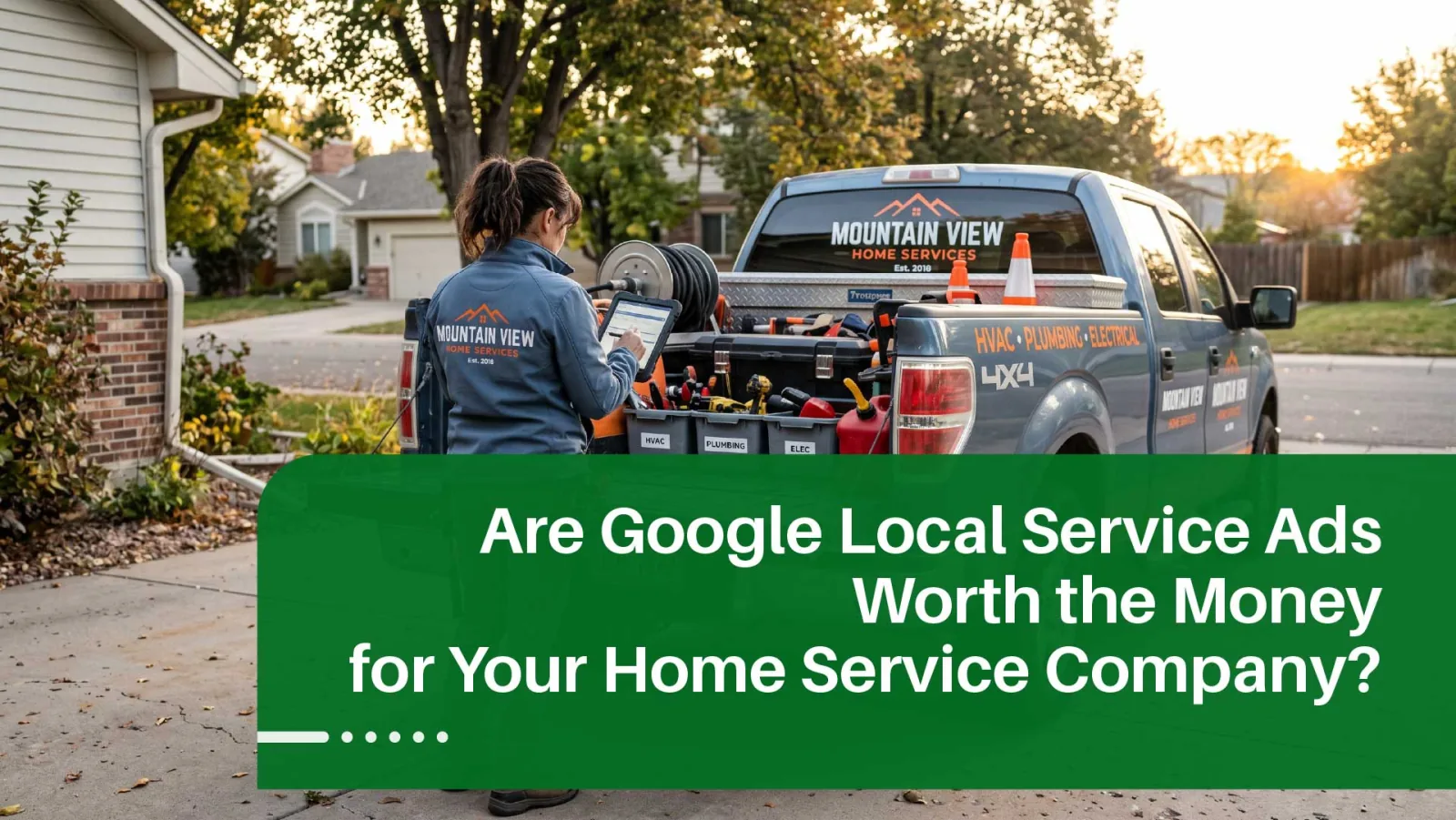
If you run paid search for a home service company, you have already met the pitch. "Just turn on Local Service Ads. It's free money at the top of the page." That sales pitch skips the part where you pay for leads you can't see the search term for, clear a background check, and hand Google control of the pricing. So the real question about Google Local Service Ads for home services is not whether they exist at the top of the page. It is whether they earn their spot in a budget you have to answer for.
This is the honest version. We market to home services companies for a living, and we would rather tell you when a channel fits than sell you one that doesn't. Here is exactly how the model works, what it actually costs by trade, what it takes to qualify, and when LSAs beat, lag, or work alongside standard Search Ads.

Written By: Adam Bennett | August 24, 2026
Adam is the president and founder of Cube Creative Design and specializes in private school marketing. Since starting the business in 2005, he has created individual relationships with clients in Western North Carolina and across the United States. He places great value on the needs, expectations, and goals of the client.
Every fall, the same meeting happens. Someone pulls up last year's budget, copies the numbers into a fresh spreadsheet, nudges a few line items, and calls it a plan. If that sounds familiar, you have plenty of company. But "what we did last year" is a strange way to choose your pest control marketing channels for 2027, especially when the return on each channel has changed so much in five years.
We work with pest control companies that are long past the startup phase. They have a budget, a marketing manager or two, and real money on the line every month. Their problem is not whether to market. It is where the next dollar should go.
This post gives you a channel-by-channel framework you can carry into a budget meeting. We will cover what the average pest control company spends, the five channels that earn their keep, why running them together beats running them alone, and where most companies are quietly overspending. The goal is simple: fewer guesses, more decisions backed by data.
Written By: Adam Bennett | August 24, 2026
Adam is the president and founder of Cube Creative Design and specializes in private school marketing. Since starting the business in 2005, he has created individual relationships with clients in Western North Carolina and across the United States. He places great value on the needs, expectations, and goals of the client.

By the time a family agrees to a shadow day, they have usually toured your campus, sat through your pitch, and quietly compared you to two or three other schools. They are not browsing anymore. They are deciding. And the person doing most of that deciding is the 12-year-old who has to walk into an unfamiliar building on Monday morning and picture spending the next six years there. A private school admissions team that treats the shadow day as an afterthought to the tour is leaving its most serious prospects to make that call with no help at all.
That is the whole case for taking shadow day marketing seriously. It sits at the bottom of the campus-visit funnel, after the open house draws the crowd and the individual tour warms the family up. It is the test drive that closes the gap between "we're interested" and "we're applying." This guide covers what a shadow day actually is, where it belongs in your funnel, how to select and train host students, how to handle logistics and capacity without burning out your staff, how to follow up, and how to measure whether any of it is working.
Written By: Adam Bennett | August 21, 2026
Adam is the president and founder of Cube Creative Design and specializes in private school marketing. Since starting the business in 2005, he has created individual relationships with clients in Western North Carolina and across the United States. He places great value on the needs, expectations, and goals of the client.
You can probably recite your callback rate from memory. You know your chemical cost per stop, your average technician productivity, and exactly how many stops fell off last Tuesday's route. Then someone asks how your marketing is performing, and the answer turns into a shrug. "Leads seem okay." "Google Ads feels expensive." That gap is the whole problem. Pest control marketing KPIs deserve the same discipline you already give your service operations, and most companies never give them that. At Cube Creative Design, we build measurement frameworks for independent pest control companies, and the pattern is almost always the same: rigorous in the field, vague in the funnel. This post fixes that with a measurement system built for how pest control actually works.
Written By: Adam Bennett | August 21, 2026
Adam is the president and founder of Cube Creative Design and specializes in private school marketing. Since starting the business in 2005, he has created individual relationships with clients in Western North Carolina and across the United States. He places great value on the needs, expectations, and goals of the client.