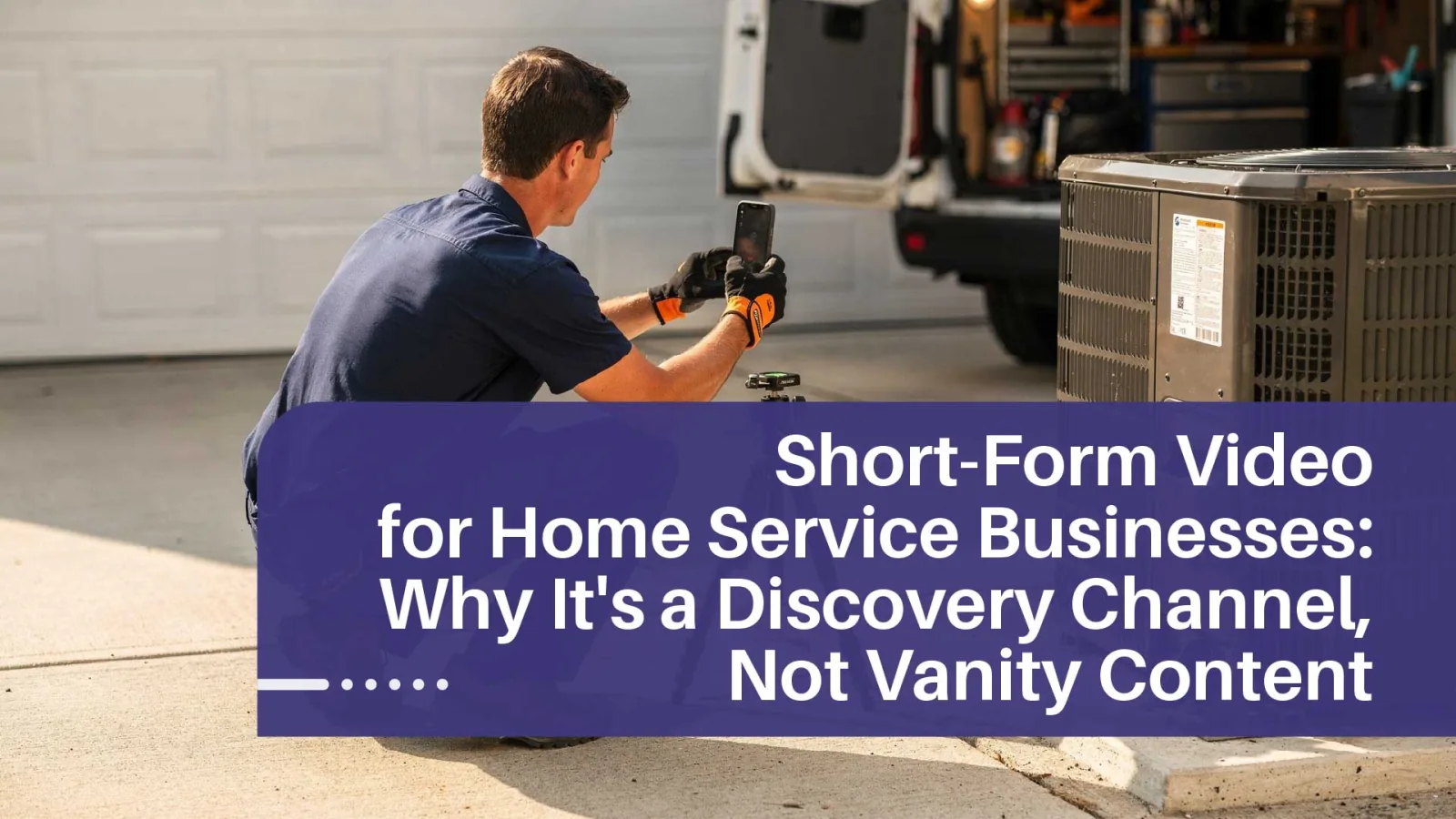
Most home service owners have quietly filed short-form video under "stuff for influencers." The crew is booked solid, the phone is ringing, and nobody has time to choreograph a dance on a roof. That instinct makes sense. It is also costing you leads.
Short-form video for home service businesses is not vanity content. It is a discovery channel that runs alongside Google, and your future customers are already there. The home services businesses that treat Reels, YouTube Shorts, and TikTok as a search-and-discovery play are showing up where homeowners now look, often before those homeowners ever type a company name into a search bar.
This post covers what to actually film on the jobsite, how long clips should run, how often a busy shop can post without wrecking the schedule, how a single shoot can feed every platform you care about, and how the right captions and setup help those clips get found in search. No influencer routine required.

Written By: Hannah Kilpatrick | August 03, 2026
Hannah Kilpatrick Cube Creative DesignHannah Kilpatrick graduated from Western Carolina University in 2021 with a Bachelor of Science in Communication with a Minor in Marketing and a Concentration in Public Relations. She has been around social media since its creation. (Meaning, she was in the first grade when Facebook became available to the general public.) As our very own professional Gen-Z, Hannah is a whiz when it comes to social media creation and paid advertising.
I'm Chad, a partner at Cube Creative Design. Incline Marketing comes up often enough in conversations with pest control company owners that I decided to write the honest, side-by-side comparison I'd want if I were the one signing the contract. This is not a hit piece. Incline has real, well-documented wins, and I'll say so plainly before I make our case.
We're a marketing agency that works with pest control companies, so yes, I have a side. But a comparison that hides the parts where the other agency is stronger is worthless to you. So here is where Incline wins, where we win, and the trade-offs in between. I'll name the situations where Incline is the better choice, because for some companies it honestly is.

Written By: Chad J. Treadway | July 31, 2026
Chad is a Partner and our Chief Smarketing Officer. He will help you survey your small business needs, educating you on your options before suggesting any solution. Chad is passionate about rural marketing in the United States and North Carolina. He also has several certifications through HubSpot to better assist you with your internet and inbound marketing.
Every pest control owner eventually asks the same question: What should a lead actually cost me? It usually comes up right after a look at the ad spend, with the uncomfortable feeling that the number has crept up and nobody decided to let it. So you go looking for a benchmark, find a national average, compare yourself to it, and walk away either falsely reassured or needlessly alarmed. Neither helps.
Here is the honest version, and I run an agency that works with exterminators, so I see these numbers across a lot of companies. There is a real range for what pest control leads cost in 2026, and it is worth knowing. But the range only tells you the neighborhood. The number that runs your business is the one you calculate from your own close rate and your own customer value. This post gives you both: the real ranges, and the math that turns a vague benchmark into a decision you can actually make.
Written By: Chad J. Treadway | July 29, 2026
Chad is a Partner and our Chief Smarketing Officer. He will help you survey your small business needs, educating you on your options before suggesting any solution. Chad is passionate about rural marketing in the United States and North Carolina. He also has several certifications through HubSpot to better assist you with your internet and inbound marketing.

A homeowner pulls up your website at 9 p.m. with water pooling under the kitchen sink. Before they read a single word, they have already decided whether you look like a company worth calling. That decision happens in about 0.05 seconds. Professional design is what wins that split-second, and for many home service companies, it is doing more selling than their best closer.
This matters most for local home services businesses trying to compete against bigger names. Your website, your trucks, your uniforms, and your printed materials all send a signal about trust before you ever pick up the phone. The good news is that you control every one of them. Here is how each one builds credibility, and how to make them work for you instead of against you.
Written By: Chad J. Treadway | July 29, 2026
Chad is a Partner and our Chief Smarketing Officer. He will help you survey your small business needs, educating you on your options before suggesting any solution. Chad is passionate about rural marketing in the United States and North Carolina. He also has several certifications through HubSpot to better assist you with your internet and inbound marketing.